
Source & license
Upstream license: MIT
License TL;DR
You can use it, change it, self-host it and sell it. Keep the original copyright and license notice with copies of the code. You don’t have to publish your changes. The authors don’t promise it will work.
Explain MIT in plain English →Summary of the main license. Separate packages and assets can have different terms.
Inspect repository ↗Read this project’s actual license ↗Repository owner
See the upstream repository for the original creator and contributors.
Maintain this project? Maintainer verification →Cloudflare hosting
Free tier eligible within limits
The static planner can be served on Cloudflare Pages without a runtime database. Optional sync consumes Pages Functions/Workers and KV quotas: 100,000 dynamic requests/day, 10ms CPU and KV operation/storage limits. Local-only use needs no cloud sync service.
Hosting requirements
- Shared-code sync is a bearer access mechanism, not per-user account authorization; configure ALLOWED_CODES and limit use to the intended trusted group.
- KV Free writes are limited to 1,000/day and storage to 1GB. Frequent device synchronization can exhaust writes before static hosting limits are reached.
- Source and configuration review establishes a deployment path and conditional costs; this candidate was not executed or load-tested.
Sources checked 01/10/2026
Repository snapshot: 25e77de. Hosting eligibility reflects the deployment documentation and listed assumptions.
- todoist ↗
``` src/app.html the whole app: styles, markup, logic (edit this) src/i18n.js UI translations, keyed by the Russian source string build.sh assembles index.html and dist/
- pages ↗
sembles index.html and dist/ from src/ deploy.sh build + publish to Cloudflare Pages index.html built app (generated — do not edit) sw.js service worker: offline cache, versioned per build manifest.json PWA manifest icons/
- kv ↗
served from Cloudflare's edge; the sync API runs as a Pages Function backed by Workers KV. The free plan is more than enough: unlimited static requests, 100k function calls/day, 1k KV writes/day (the app only writes when something actually changed). You need a Cloudfl
- free-tier-eligible ↗
# Planly **A minimalist day planner that lives in your browser.** One HTML file, no framework, no accounts, no server required. Works offline, installs to the home screen, and syncs between devices through a single access code when you want it to. **[Live demo →](https://planly.site)** · [Русская версия →](README.ru.md)  <img src="docs/drag.gif" width="260" align="right" alt="Dragging a task to a new time"> - **Day** — a vertical timeline where each task is a block as tall as its duration. Tap a time to add, drag to move, pull the bottom edge to resize. Overlaps split into columns. A list view shows the same day as rows with free windows between tasks. - **Repeats** — every day or chosen weekdays. Edits apply to one day;
- free-tier-eligible ↗
| **Free** | 100,000 per day | No charge for duration | 10 milliseconds of CPU time per invocation |
- free-tier-eligible ↗
| Keys read | 100,000 / day | 10 million/month, + $0.50/million |
- free-tier-eligible ↗
| Keys written | 1,000 / day | 1 million/month, + $5.00/million |
- MIT ↗
MIT License Copyright (c) 2026 Daniil Kokorev Permission is hereby granted, free of charge, to any person obtaining a copy of this software and associated documentation files (the "Software"), to deal in the Software without restriction, including without limitation the rights to use, copy, modify, merge, publish, distribute, sublicense, and/or sell copies of the Software, and to permit persons to whom the Software is furnished to do so, subject to the following conditions: The above copyright notice and this permission notice shall be included in all copies or substantial portions of the Software. THE SOFTWARE IS PROVIDED "AS IS", WITHOUT WARRANTY OF ANY KIND, EXPRESS OR IMPLIED, INCLUDING BUT NOT LIMITED TO THE WARRANTIES OF MERCHANTABILITY, FITNESS FOR A PARTICULAR PURPOSE AND NONINFRINGEMENT. IN NO EVENT SHALL THE AUTHORS OR COPYRIGHT HOLDERS BE LIABLE FOR ANY CLAIM, DAMAGES OR OTHER LIABILITY, WHETHER IN AN ACTION OF CONTRACT, TORT OR OTHERWISE, ARISING FROM, OUT OF OR IN CONN
- architecture ↗
sembles index.html and dist/ from src/ deploy.sh build + publish to Cloudflare Pages index.html built app (generated — do not edit) sw.js service worker: offline cache, versioned per build manifest.json PWA manifest icons/
- architecture ↗
served from Cloudflare's edge; the sync API runs as a Pages Function backed by Workers KV. The free plan is more than enough: unlimited static requests, 100k function calls/day, 1k KV writes/day (the app only writes when something actually changed). You need a Cloudfl
- architecture ↗
# Planly **A minimalist day planner that lives in your browser.** One HTML file, no framework, no accounts, no server required. Works offline, installs to the home screen, and syncs between devices through a single access code when you want it to. **[Live demo →](https://planly.site)** · [Русская версия →](README.ru.md)  <img src="docs/drag.gif" width="260" align="right" alt="Dragging a task to a new time"> - **Day** — a vertical timeline where each task is a block as tall as its duration. Tap a time to add, drag to move, pull the bottom edge to resize. Overlaps split into columns. A list view shows the same day as rows with free windows between tasks. - **Repeats** — every day or chosen weekdays. Edits apply to one day; "apply to all future" pushes them down the series. - **Calendar** — tap the date to open a month view; days with tasks are underlined. - **Tasks** — things without a time, in folders you create, with
- architecture ↗
sembles index.html and dist/ from src/ deploy.sh build + publish to Cloudflare Pages index.html built app (generated — do not edit) sw.js service worker: offline cache, versioned per build manifest.json PWA manifest icons/
- architecture ↗
served from Cloudflare's edge; the sync API runs as a Pages Function backed by Workers KV. The free plan is more than enough: unlimited static requests, 100k function calls/day, 1k KV writes/day (the app only writes when something actually changed). You need a Cloudfl
Upstream screenshot · drkokorev/Planly repository contributors ↗. Depicts the upstream project. We have not deployed and tested a fresh installation here.
What it can replace
Compare the workflow you need. These mappings describe overlap; full feature parity requires a separate comparison.
 Todoist ↗
Personal day planning, task timelines, recurring items and notes; no team task permissions, enterprise integrations or complete Todoist parity.
See supporting source ↗How it works
The shape of Planly on Cloudflare, and how it stacks up against the rented tools it replaces.
Architecture
Diagram based on the linked repository documentation. See the sources and hosting assumptions above.
View upstream source ↗Configuration and workflow sources
Reviewed commit 25e77defc18c. Files were read as data; upstream applications and CI jobs were not executed.
Deployment configuration · 1 files
Cloudflare Pages · example/template, excluded from overview · compatibility 2026-01-01
planly · default
PLANLY_SYNC→ KV
Named environments are separate deployments. Bindings are shown only where declared. Configured routes are URL patterns, not verified application endpoints.
Runtime source · handlers, binding usage and workflow steps
Observed TypeScript/JavaScript declarations from Worker entrypoints and resolved relative imports. Calls and workflow steps may run conditionally; their listed order is not a proven end-to-end request flow. Router declarations may be mounted under a prefix or may not be registered. This shows code wiring, not a successful deployment or runtime test. Dynamic wiring, aliases and generated code may not resolve.
No direct runtime declarations resolved from this snapshot. Generated framework bundles or dynamic entrypoints need manual tracing.
Build and deployment pipeline · 0 GitHub Actions workflows
Repository CI declarations, separate from runtime request processing. Job dependencies and conditions are shown as written; long commands are shortened with an ellipsis; a workflow file does not prove a recent successful run.
No GitHub Actions workflow was found in the collected tree. Deployment may be manual or configured elsewhere.
Repository README
View original on GitHub ↗Full upstream document by @drkokorev · README.md · snapshot 25e77de
Planly
A minimalist day planner that lives in your browser. One HTML file, no framework, no accounts, no server required. Works offline, installs to the home screen, and syncs between devices through a single access code when you want it to.
Live demo → · Русская версия →
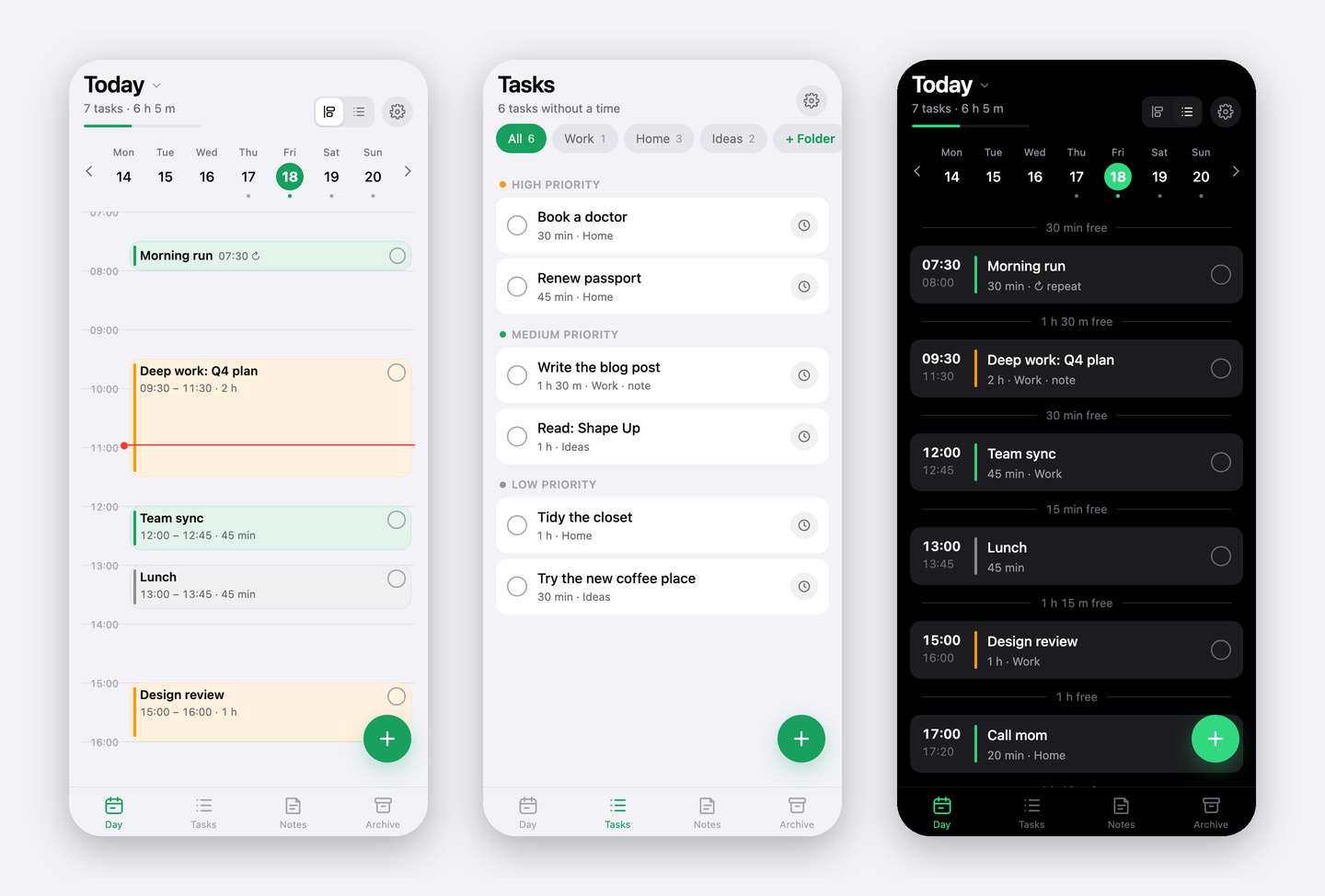
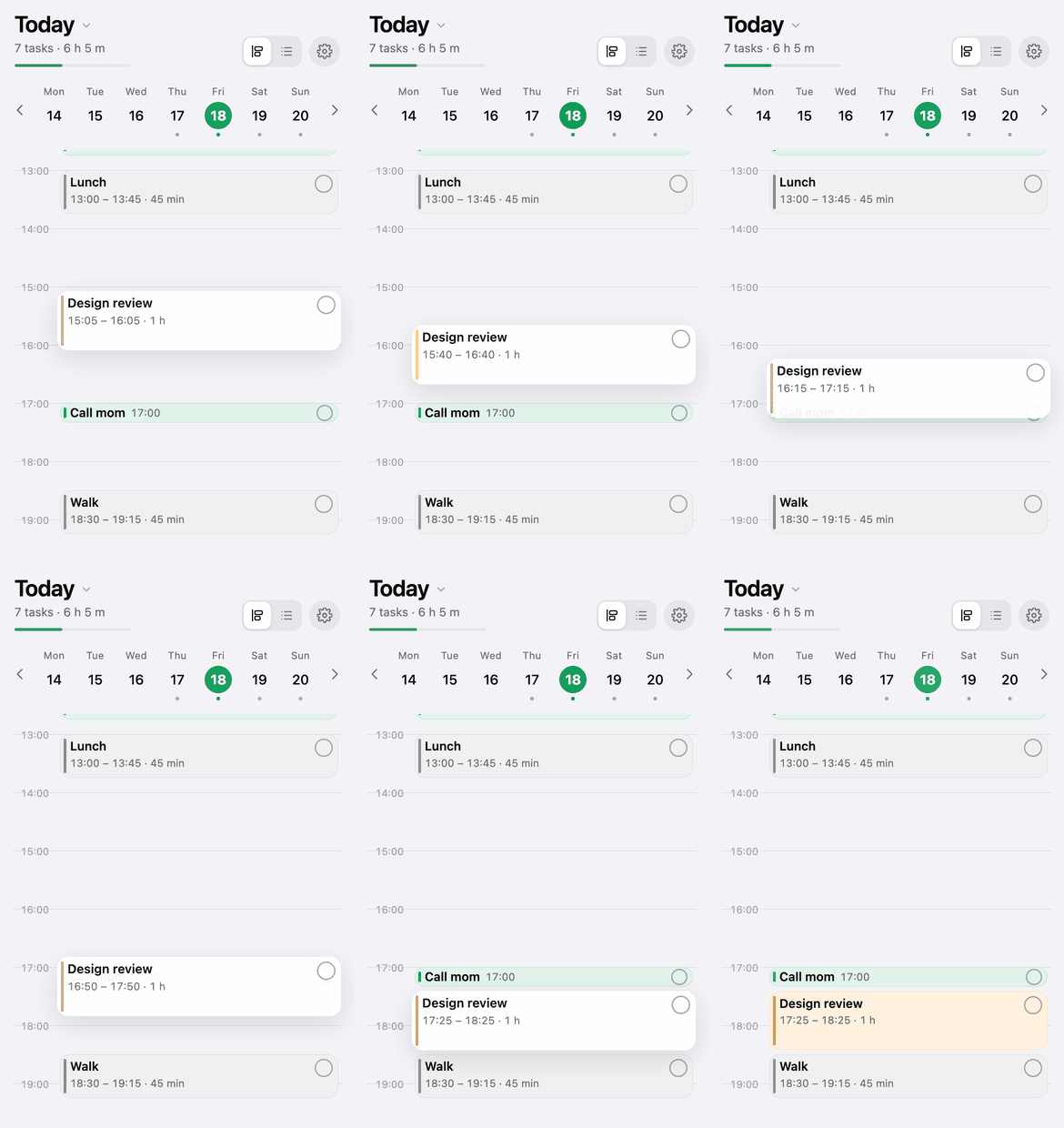
- Day — a vertical timeline where each task is a block as tall as its duration. Tap a time to add, drag to move, pull the bottom edge to resize. Overlaps split into columns. A list view shows the same day as rows with free windows between tasks.
- Repeats — every day or chosen weekdays. Edits apply to one day; "apply to all future" pushes them down the series.
- Calendar — tap the date to open a month view; days with tasks are underlined.
- Tasks — things without a time, in folders you create, with three priorities. Drag to reorder or change priority; schedule into a free window or automatically.
- Notes — drafts by topic with headings, bullet and numbered lists, bold and italic. Saves as you type.
- Archive — completed items, grouped by day, auto-removed after two weeks.
- Sync — optional. One code = one shared list. Per-item merge by modification time, tombstones for deletions, offline-first.
- Light/dark theme, seven accent colors, six languages (en, ru, es, de, zh, hi), keyboard shortcuts on desktop.
Everything lives in the browser's storage on your device. The server, when you use one, holds a single JSON document per access code and knows nothing else.
The demo's sync is invite-only (it's the author's instance); deploy your own in five minutes — see below.
Try it locally
git clone https://github.com/<you>/planly && cd planly
python3 -m http.server 4321
Open http://localhost:4321. The app works fully offline once loaded; only sync needs a backend.
Project layout
src/app.html          the whole app: styles, markup, logic (edit this)
src/i18n.js           UI translations, keyed by the Russian source string
build.sh              assembles index.html and dist/ from src/
deploy.sh             build + publish to Cloudflare Pages
index.html            built app (generated — do not edit)
sw.js                 service worker: offline cache, versioned per build
manifest.json         PWA manifest
icons/                app icons (make_icons.py regenerates them)
functions/api/sync.js sync API as a Cloudflare Pages Function (KV storage)
wrangler.example.toml Pages project config template (copy to wrangler.toml, git-ignored)
server/               self-hosted alternative: Node server (app + sync), nginx and systemd examples
Dockerfile            whole instance in one container
docker-compose.yml    the same, with a named volume for the data
tools/shots/          headless-Chrome rig that renders the README screenshots
docs/                 screenshots, GIF and the social preview image
Option A — Cloudflare Pages + KV (free, recommended)
Static files are served from Cloudflare's edge; the sync API runs as a Pages Function backed by Workers KV. The free plan is more than enough: unlimited static requests, 100k function calls/day, 1k KV writes/day (the app only writes when something actually changed).
You need a Cloudflare account and Node.js 18+.
npx wrangler login                                     # opens the browser once
npx wrangler pages project create planly --production-branch=main
npx wrangler kv namespace create PLANLY_SYNC           # prints the namespace id
Copy the example config and put the printed id into it (wrangler.toml is
git-ignored, so your ids stay out of the repository):
cp wrangler.example.toml wrangler.toml # then edit the id line
Then deploy:
./deploy.sh
The script builds dist/, stamps a new cache version into sw.js and uploads
everything with wrangler pages deploy. The app is live at
https://planly-<hash>.pages.dev; every later ./deploy.sh ships an update
that installed home-screen apps pick up on their next launch.
Custom domain. If your domain's DNS is on Cloudflare: Workers & Pages →
your project → Custom domains → Set up a custom domain. Cloudflare creates the
DNS record and the certificate. If DNS is elsewhere, add a CNAME to
planly-<hash>.pages.dev (apex domains need CNAME flattening, which most
registrars lack — moving DNS to Cloudflare is the easy path).
Restricting sync to known codes. By default any code works. To allow only specific codes (e.g. while the deployment is private), set a secret with a comma-separated list:
printf 'AAAA-BBBB-CCCC-DDDD,EEEE-FFFF-GGGG-HHHH' | npx wrangler pages secret put ALLOWED_CODES --project-name planly
Other codes get 403 not_allowed and the app shows "code not allowed on the server".
Delete the secret to open sync again.
If
wrangler pages project createcomplains about a missingworkers.devsubdomain, re-run it once with--forceto create a classic Pages project.
Option B — Docker (one container, app + sync)
git clone https://github.com/drkokorev/Planly && cd Planly
docker compose up -d
That's the whole thing: http://localhost:8080 serves the app and the sync API from the same origin, with documents in a named volume. Plain Docker works too:
docker build -t planly .
docker run -d -p 8080:8080 -v planly-data:/data --name planly planly
Put it behind your usual reverse proxy with a certificate — service workers, offline mode and "Add to Home Screen" all require a secure origin.
The image is node:22-alpine with no dependencies to install, runs as the
unprivileged node user and has a healthcheck. Useful environment variables:
| Variable | Default | Meaning |
|---|---|---|
PORT / HOST |
8080 / 0.0.0.0 |
where the server listens |
DATA_DIR |
/data |
one JSON file per access code |
ALLOWED_CODES |
unset | comma-separated allowlist; unset accepts any code |
SERVE_STATIC |
enabled | 0 turns off static serving (sync API only) |
Updating: git pull && docker compose up -d --build. Your data lives in the
volume, not in the image.
Option C — your own server, without Docker
The app is static: copy index.html, sw.js, manifest.json, version.txt
and icons/ (all produced in dist/ by ./build.sh) to any web root behind
HTTPS. HTTPS is required for the service worker and for "Add to Home Screen".
For sync, run the reference server — a single Node file with no dependencies that stores one JSON file per code:
PORT=8787 DATA_DIR=/var/lib/planly SERVE_STATIC=0 node server/sync-node.js
and proxy /api/sync to it from your web server. server/nginx.example.conf
is a complete nginx site (static files with correct cache headers + the proxy),
server/planly-sync.service a systemd unit. Set ALLOWED_CODES in the unit's
environment to restrict access, or leave it unset to allow any code.
The same file can serve the app itself instead of nginx — drop SERVE_STATIC=0
and point STATIC_DIR at the folder with index.html. That is exactly what the
Docker image does.
The app calls api/sync relative to its own URL, so it works both at a domain
root and in a sub-folder.
Any other backend works too — the protocol is two endpoints:
GET  /api/sync?code=XXX                → 200 { version, updatedAt, doc }   (doc: null if none)
PUT  /api/sync?code=XXX  { base, doc } → 200 { version }
                                       → 409 { version, doc }  server is ahead: merge and retry
version is an integer that grows on every write; the client sends the
version it based its document on, so two devices writing at once never lose
data — the loser merges and retries. Codes are [A-Za-z0-9-]{8,64}; the client
generates 16 characters from a 32-symbol alphabet.
Using the app
Install. Open the URL in Safari (iPhone) or Chrome (Android/desktop) → Share → Add to Home Screen (Chrome: Install app). It launches full-screen, works offline and checks for updates when you return to it.
Day. Tap an empty time to add a task there. Long-press a block (or just drag with a mouse) to move it; the bottom edge changes duration. The circle in the corner marks it done and sends it to the archive. The toggle in the header switches between timeline and list; tap the date for the month calendar.
Repeats. In a scheduled task's card: Repeat → Every day or Weekdays. The app creates the task on every matching day five weeks ahead. Edits in a repeating task's card apply to that day only; Apply to all future pushes them to the whole series, Delete only this one skips one day, Delete all repeats removes the series (completed days stay in the archive).
Tasks. Untimed items with folders and priorities. Drag between priority sections. The clock button opens scheduling: pick a date, a free window, a manual time, or let it choose the first free window.
Sync. Settings → Sync between devices → Enable creates a code. On the other device enter it under Code from another device. Devices exchange changes on launch, when you return to the app, every two minutes, and a few seconds after each edit. The code is the only key to your data — keep it like a password. Losing it means losing the server copy (your device copy stays).
Backup. Settings → Copy backup puts the whole dataset as JSON on the clipboard; Paste from clipboard restores it. Storage is per URL: the same app opened at a different address starts empty.
Keyboard (desktop). ←/→ day, T today, N new task, V timeline/list,
1–4 tabs, Esc close.
How data is stored
| Layer | What | Where | Lifetime |
|---|---|---|---|
| App cache | index.html, icons, manifest |
Service Worker cache, versioned per build | replaced on every update |
| Your data | tasks, folders, notes, series, settings | localStorage, key planly.v1 |
until you clear site data or delete the home-screen app |
| Sync copy | one JSON document | KV (or a file on your server), key = code | 400 days after the last write |
Sync merges per item: each task, note, folder and series carries the time of
its last change, the newer one wins. Deletions are kept as tombstones for 30
days so a device that was offline cannot resurrect them. Repeating tasks are
materialized with deterministic ids (<series>@<date>), so two devices that
create the same day independently converge on one record.
Development
./build.sh            # src/ → index.html + dist/
./deploy.sh           # build + wrangler pages deploy
python3 make_icons.py # regenerate icons/
build.sh stamps the build time into the settings screen and version.txt;
the running app compares them to offer an update. sw.js is network-first:
online you always get fresh files, offline you get the cache.
Adding a language: add a block to src/i18n.js (keys are the Russian UI
strings; nouns with counts are objects with one/few/many/other forms chosen
via Intl.PluralRules) and a row to LANGS in src/app.html. Missing keys
fall back to Russian, so partial translations are visible rather than silent.
License
MIT
Frequently asked about Planly
What is Planly?+
Planly is a self-hosted Todoist alternative built on the Cloudflare developer platform. A local-first daily timeline with optional shared Cloudflare sync
What does Planly replace?+
Planly is listed as an alternative to Todoist. Compare the features and tradeoffs before migrating.
What Cloudflare primitives does Planly use?+
Planly is built on KV, Pages.
How much does Planly cost to run?+
The static planner can be served on Cloudflare Pages without a runtime database. Optional sync consumes Pages Functions/Workers and KV quotas: 100,000 dynamic requests/day, 10ms CPU and KV operation/storage limits. Local-only use needs no cloud sync service. Shared-code sync is a bearer access mechanism, not per-user account authorization; configure ALLOWED_CODES and limit use to the intended trusted group. KV Free writes are limited to 1,000/day and storage to 1GB. Frequent device synchronization can exhaust writes before static hosting limits are reached. Source and configuration review establishes a deployment path and conditional costs; this candidate was not executed or load-tested. Check current Cloudflare pricing before deploying.
Is Planly open source?+
The upstream repository declares the MIT license. Read its terms at https://raw.githubusercontent.com/drkokorev/Planly/25e77defc18cc6e004b14283f1a1a68e861f2369/LICENSE. Source code and contributor credit are available at https://github.com/drkokorev/Planly.
Discussion · 0
sign in to comment →