Open source WordPress alternatives you can host yourself on Cloudflare
If you want an open source, self-hosted WordPress alternative that runs on Cloudflare, six catalog projects list WordPress as the service they replace: SonicJS (a headless CMS), Monolith (a blog system with a WordPress import), Microfeed (a feed-based CMS with themes), VibeCMS (Markdown publishing for AI agents), Qingyu Blog and Cloudflare Worker Blog (small blogs). None replaces WordPress's plugin and theme ecosystem, and Cloudsteading has not deployed any of them.
By Cloudsteading · Sources checked 2026-11-11 · Independent guide
What you can and cannot replace
WordPress describes itself as "the open source publishing platform of choice for millions of websites worldwide", with design built on blocks and themes (WordPress.org, checked 9 November 2026). People who search for a WordPress alternative usually want one part of that: a blog they own, a simple site with a dashboard, or a content backend for their own front end.
The catalog lists six projects that name WordPress as the service they replace, and each one covers a slice of it. Every row below describes what the project's own README and configuration declare; none is a test deployment. None claims to match WordPress's plugin and theme ecosystem, and the catalog's own scope notes say so.
WordPress alternatives that run on your own Cloudflare account
| Project | License | Best for | What it lacks next to WordPress |
|---|---|---|---|
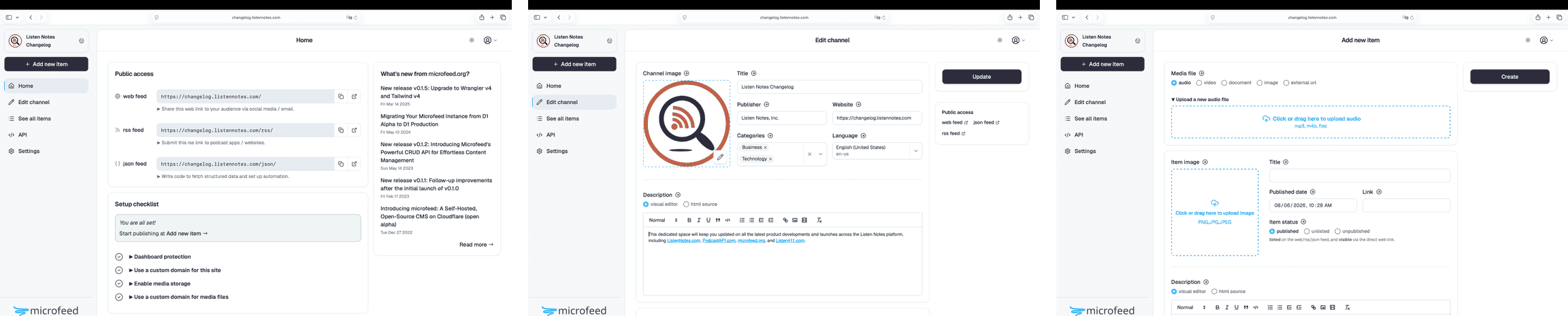
| Microfeed | AGPL-3.0 | A site, blog, podcast or link feed with an admin dashboard, versioned themes, RSS and a JSON API | No WordPress plugin ecosystem; the README calls it open alpha |
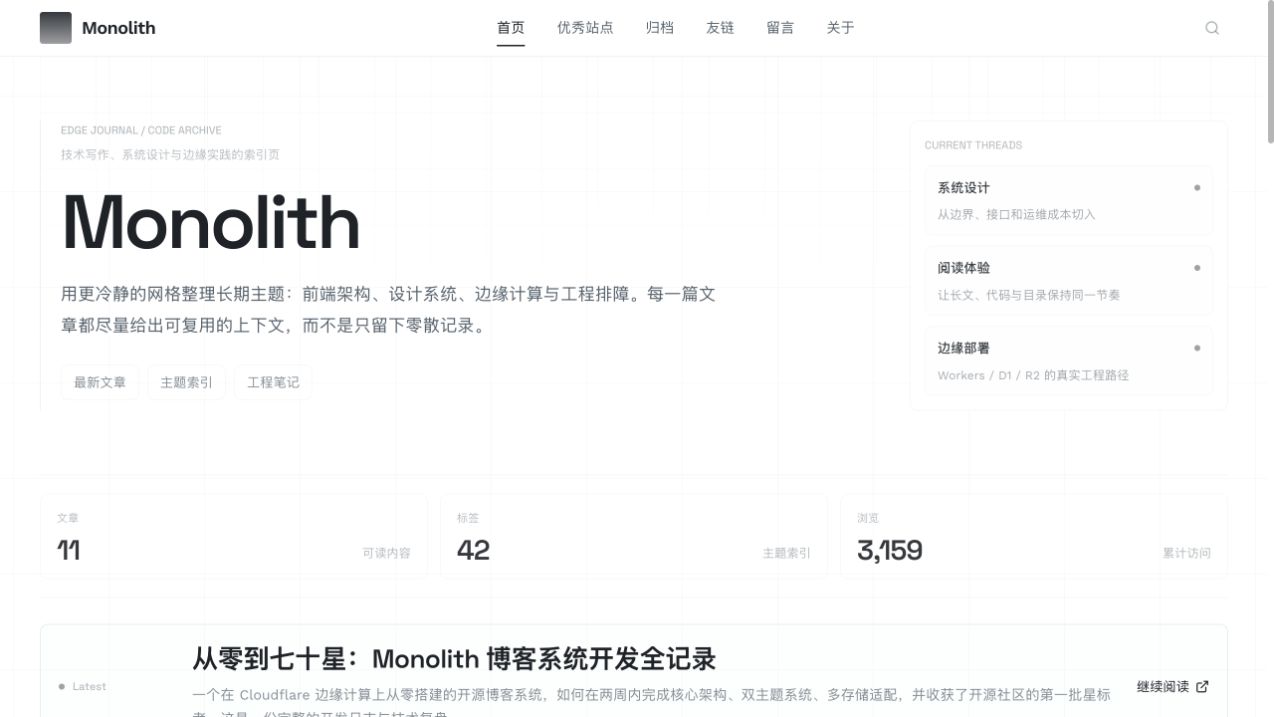
| Monolith | MIT | A Markdown blog with drafts, scheduled posts, search and a one-click WordPress import | No PHP plugin or theme compatibility; the README is in Chinese |
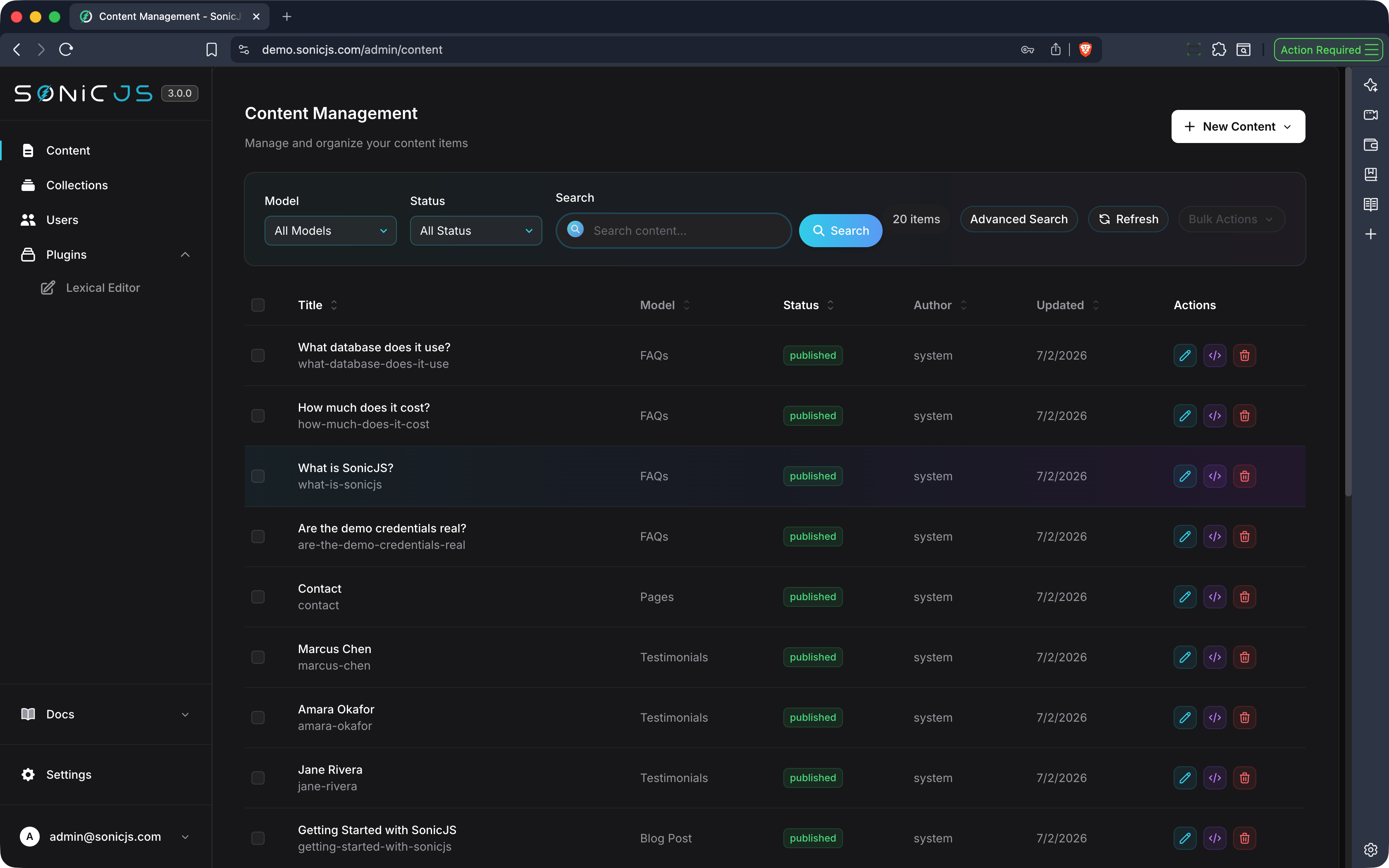
| SonicJS | MIT | A headless CMS: content models in TypeScript, an admin interface, REST and GraphQL | No front-end themes; you build the public site |
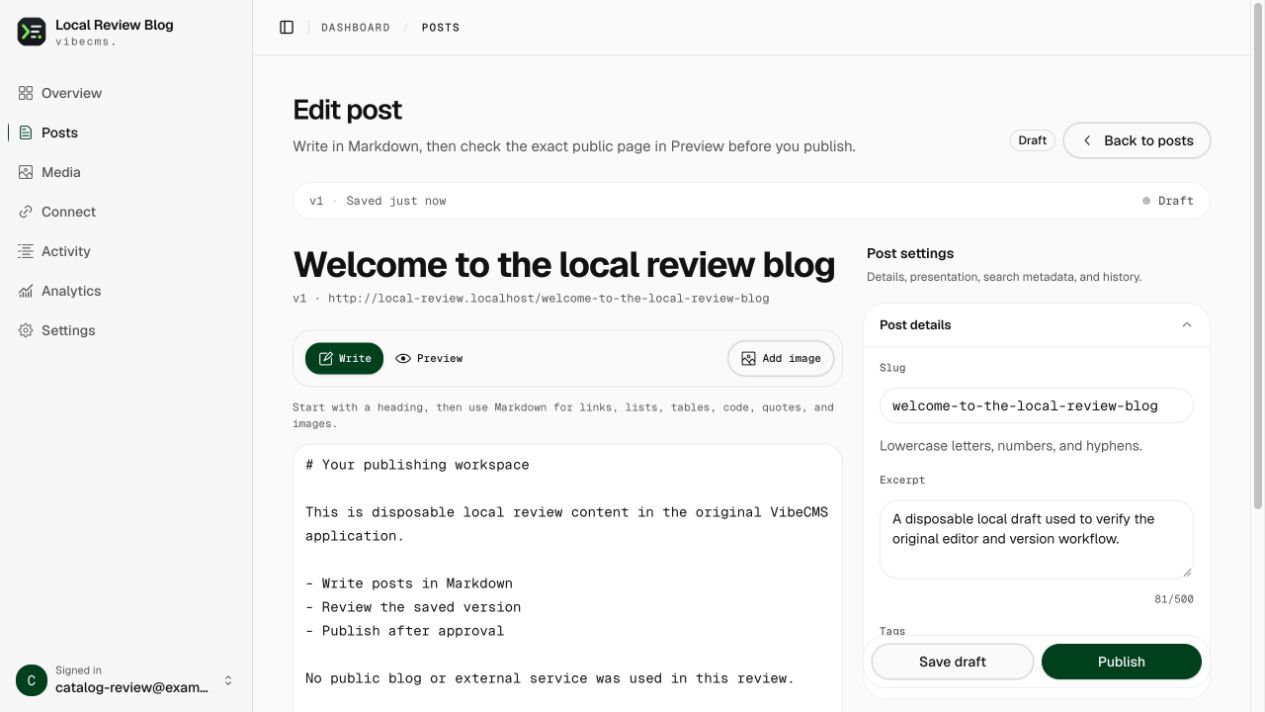
| VibeCMS | AGPL-3.0 | Markdown posts that AI agents publish through MCP or a REST API, with versions and media | No plugin or theme parity; a conservative setup assumes Workers Paid |
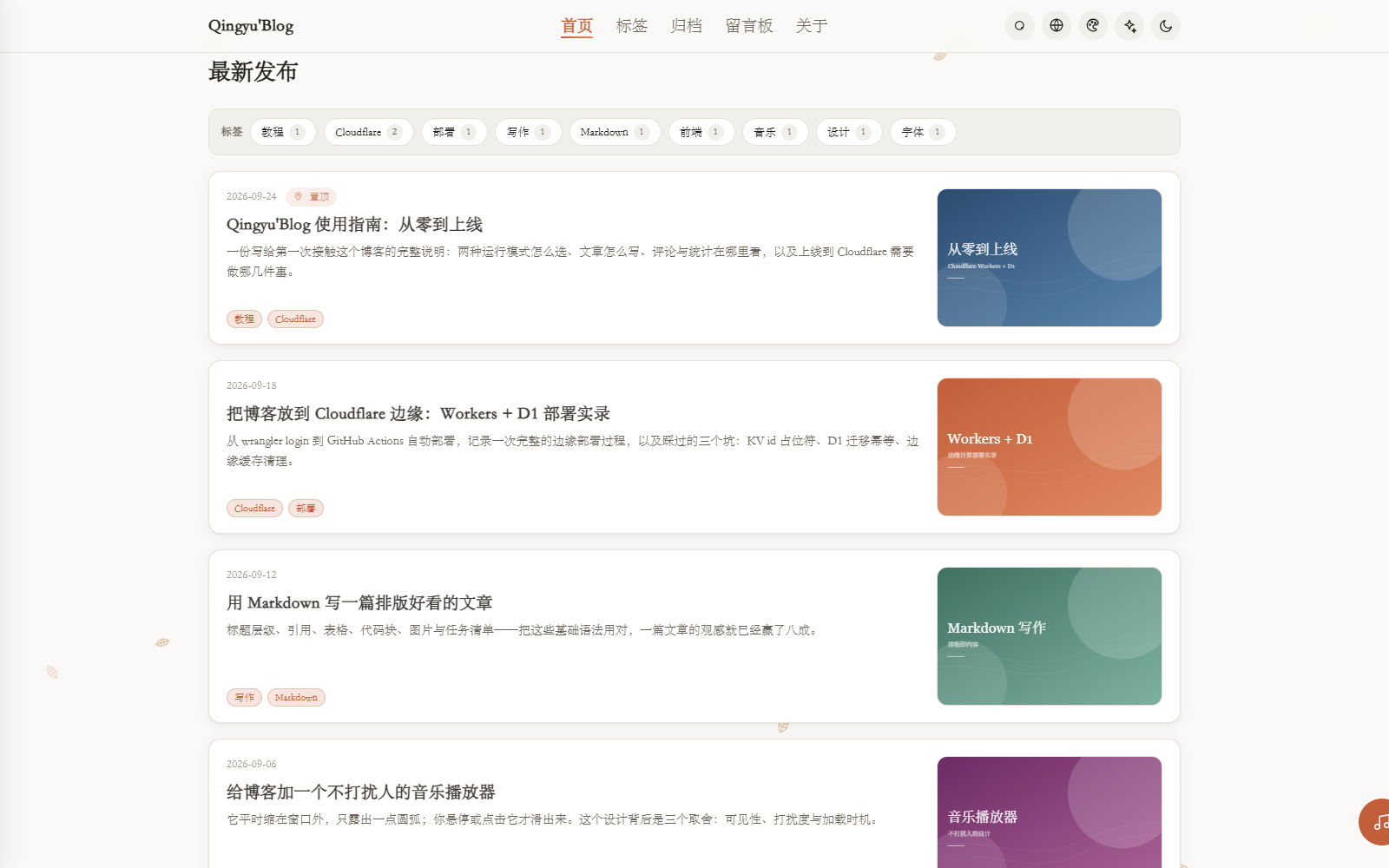
| Qingyu Blog | MIT | A personal or small multi-author blog with comments, stats and email subscriptions | Its README documents two home-page themes of its own, but no plugin system, memberships or paid subscriptions |
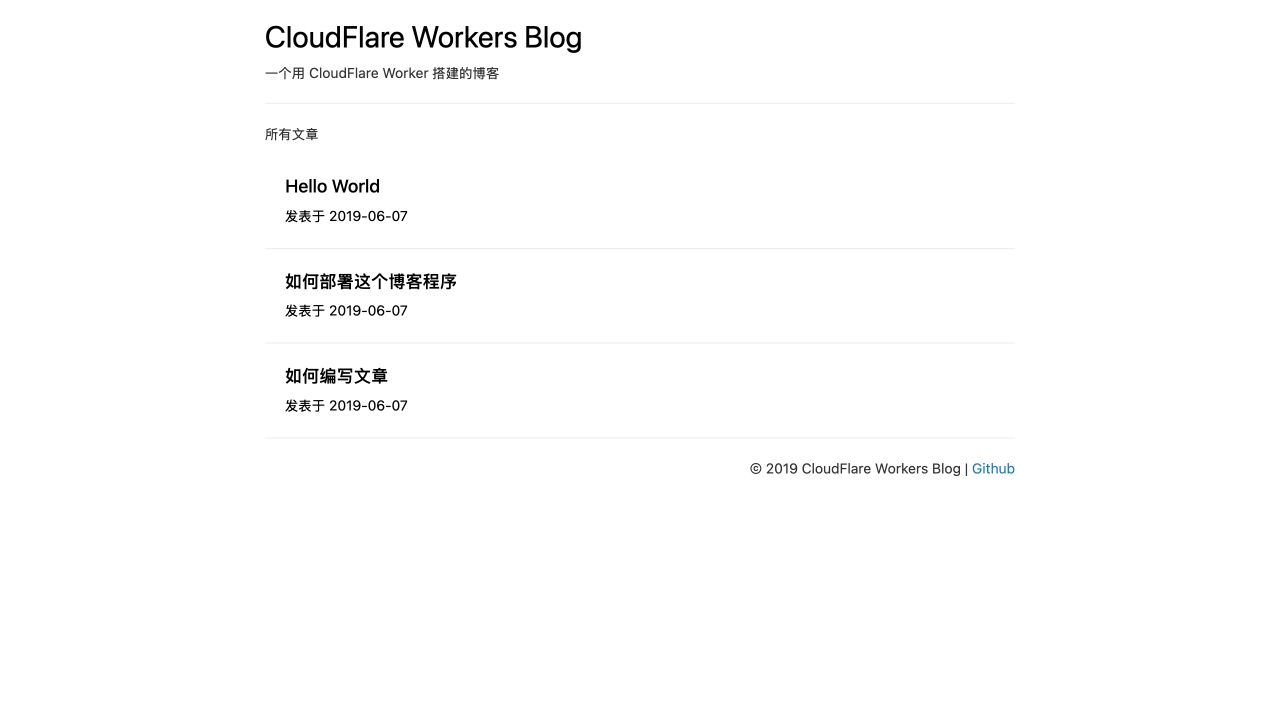
| Cloudflare Worker Blog | MIT | A tiny Markdown blog read from a GitHub repository | No admin dashboard, plugins or subscriptions; legacy code with a manual setup |
Each project page shows the README, license and architecture at a pinned commit. Architecture diagrams describe the setup each project declares, not something we ran.
Microfeed: the closest to a WordPress-style site
The Microfeed README describes "a lightweight content management system (CMS) self-hosted on Cloudflare" that publishes posts, audio, video, photos, documents and links to a website, an RSS feed and a JSON feed. It says that if you have used WordPress before, you will find the admin dashboard familiar. Themes are Mustache templates stored as immutable versions in D1: you draft, preview, install and then activate a version, and the previous one stays available for rollback. The README also lists a headless API, signed webhooks, custom domains, search, editable robots.txt, llms.txt and sitemap.xml, and snapshot backups of the database, media bucket and themes.
It runs on Workers, D1 and R2, with Queues for webhooks in the root configuration. The catalog's hosting note says low-volume publishing can fit the Free allowances, that Queues Free includes 10,000 operations a day, and that large media archives will pass R2's 10 GB-month free storage. The README's own FAQ says Microfeed is "still in open alpha phase", which matters if you are moving a site that earns money. Microfeed is AGPL-3.0.
What it lacks next to WordPress: no plugin ecosystem, and no verified route for importing an existing WordPress site.
Monolith: Markdown blog with a WordPress import
Monolith's README describes a blog system on Cloudflare's edge with a Markdown editor and live preview, drafts, scheduled publishing, pinned posts, series, standalone pages, full-site search, sitemap, RSS and JSON-LD. Its import feature lists WordPress, Ghost, Hexo, Hugo, Jekyll and Halo. We did not run it, and the README does not specify whether comments, custom fields or plugin content are imported. Test these before migrating.
The deployment is two parts: a Hono Worker API with D1, R2 and a one-minute cron, and a React front end on Pages that proxies /api/* to the Worker. The README is written in Chinese. Settings such as Turnstile login protection, rate limits, analytics and robots rules live in the admin console. License: MIT.
What it lacks next to WordPress: PHP plugin and theme compatibility. The catalog's scope for it excludes membership billing and managed-service parity.
SonicJS: a headless CMS, not a theme-driven site
SonicJS calls itself a headless CMS "born on the edge". You define content types as TypeScript, and it generates a REST API and an admin interface. The README also lists version history, scheduling, a draft-to-published workflow with roles, an opt-in GraphQL plugin, an MCP server and a plugin API. The starter configuration declares a Worker with a D1 database, an R2 media bucket and a KV cache namespace.
Headless means no public website comes with it. If you want a WordPress-like site, you build the front end that reads its API. Pick it if you are already a developer and want WordPress's content editing without its page rendering. The README says SonicJS can also run in Docker with SQLite, and that commercial support is optional and paid. The catalog warns to use the starter configuration, not the committed CI database and bucket, and to replace default admin credentials. License: MIT.
VibeCMS: for sites that agents publish to
VibeCMS describes itself as "the CMS your agents publish into": Markdown posts, versions and media over scoped MCP tokens or a REST API, with an activity log and a public blog on its own Worker host. A SELF_HOSTED=true switch turns off its hosted billing. It needs two Workers (an API and dashboard Worker, and an Astro public-blog Worker) sharing D1 and R2, and two secrets, BETTER_AUTH_SECRET and TOKEN_PEPPER.
On cost, the catalog's hosting note assumes Workers Paid from $5 USD an account a month for a small installation, and email verification needs a current Email Service entitlement. License: AGPL-3.0-or-later.
What it lacks next to WordPress: a documented theme or plugin extension system: the reviewed README does not describe one. It describes a blog dashboard, not a general site builder.
Qingyu Blog and Cloudflare Worker Blog: two small blogs
Qingyu Blog is a personal or small multi-author blog written in plain JavaScript with no framework, build tool or runtime dependencies, according to its README. It stores articles, comments and stats in KV and D1, deploys either to Pages or as a Worker through GitHub Actions, and sends optional subscriber email through Resend, a separate service. Resend's Free plan includes 3,000 emails a month with a limit of 100 a day, and its Pro plan is $20 USD a month for 50,000 emails (Resend pricing, checked 11 November 2026). The README states that the Cloudflare free allowances are enough for a personal blog; that is the author's statement, not ours. Configure BLOG_ADMIN_SETUP_KEY before exposing the site, then initialize your admin password through the dashboard using that key. License: MIT.
Cloudflare Worker Blog is the smallest: a single Worker that reads Markdown posts and a list.json index from a GitHub repository. There is no dashboard, and the README points to a PHP command-line helper for writing. It is legacy code with a manual setup. Notes from the catalog's review of the original code record that the article index loaded but opening a post left the body blank in a local run, because a bundled highlighting library failed. Treat it as a starting point to adapt, not a ready replacement. License: MIT.
Deploy Microfeed, step by step
These follow the Microfeed README's install options. Cloudsteading has not run them against a production Cloudflare account.
- Decide how to deploy. The README offers three routes: a local AI coding agent, GitHub Actions on your fork, or the management command run by hand. The steps below use the manual command.
- Sign in to Cloudflare in your browser when asked. Every route uses browser authorization, and R2 must be enabled on your account if you want to upload media.
- In a terminal, run
npx @microfeed/cli manageand follow its instructions until it reports that deployment is verified. - Open the admin dashboard and sign in with the built-in email and password login.
- Create a post, then open Settings and Themes to choose how the public site looks. The bundled
microfeed.defaulttheme is active on a new site. - Add a custom domain and decide whether the site is Public, Headless or Offline, using the options in the dashboard and the README's domains guide.
- Create a backup before you rely on it:
npx @microfeed/cli manage snapshot create --instance <instance-name> --output backup.tar.gz. The archive holds admin password hashes and is not encrypted, so store it accordingly.
If you need to bring posts from WordPress, look at Monolith first: its README documents deployment with npx wrangler login followed by npm run deploy:cloudflare, with secret setup in its wiki.
Will it stay free?
Workers Free allows 100,000 requests a day and 10 ms of CPU per invocation. D1 Free allows 5 million rows read and 100,000 rows written a day with 5 GB of storage. Workers KV allows 1,000 key writes a day. R2's free tier is 10 GB-month of Standard storage, with 1 million Class A and 10 million Class B operations a month (Cloudflare pricing pages, checked 9 November 2026). A small blog with a few hundred readers a day is a small workload. A busy site, a large media library, frequent writes or a cron that runs every minute can pass a limit first, and Pages Functions requests share the Workers allowance. Each project page lists the allowances its setup depends on.
Other self-hostable options outside the catalog
Ghost and Hugo are other self-hostable options. They are not in the catalog, and we have not reviewed them, including for Cloudflare compatibility. Facts are from their own GitHub repositories, checked 9 November 2026.
- Ghost describes itself as independent technology for modern publishing, memberships, subscriptions and newsletters. License: MIT.
- Hugo is a static site generator, described as "the world's fastest framework for building websites". License: Apache-2.0. It has no admin dashboard, so it suits people comfortable editing files.
Before you switch
- Export your WordPress content first and keep the export. Import a few posts, and check images, links, categories and any content created by plugins.
- List the plugins you rely on (forms, SEO, caching, e-commerce, memberships) and decide what replaces each. Check each plugin's functions against the project's built-in features and identify any gaps.
- Decide whether you want a site with a dashboard (Microfeed, Monolith, Qingyu Blog), a content backend (SonicJS, VibeCMS) or a few files in a repository (Cloudflare Worker Blog).
- Keep your URLs where you can. Plan redirects from old WordPress addresses to the new ones, and test them.
- Back up D1 and R2 data and plan to update the project when it changes upstream.
- Check the AGPL terms if you change Microfeed or VibeCMS and let others use your copy.
We read each README, configuration and license at the pinned commit linked on its project page. No deployment, import or migration of any project here was tested by Cloudsteading. For the wider picture, see what self-hosting is, the self-hosted RSS reader guide and the self-hosted note-taking app guide. If you maintain one of these projects and something here is wrong, you can ask for a correction or removal through support.
Common questions
What is a good open source alternative to WordPress?
Of the projects in the Cloudsteading catalog, Microfeed is the closest to a WordPress-style site: an admin dashboard, posts, media, versioned themes and a public website, under AGPL-3.0. Monolith is the one whose README advertises a WordPress import. SonicJS is a headless CMS, so you build the front end yourself. None has a WordPress-style plugin marketplace. Outside the catalog, Ghost and Hugo are well-known open source options.
Can I host a WordPress alternative on Cloudflare for free?
A small blog may fit, conditionally. SonicJS, Monolith, Microfeed, Qingyu Blog and Cloudflare Worker Blog are configured around Workers, D1, KV, R2 or Queues, which have free allowances (100,000 Worker requests a day, 5 GB of D1 storage, 1,000 KV writes a day on the Free plan). Free is not guaranteed: R2 can need a billing-enabled account, and the catalog's hosting note for VibeCMS assumes Workers Paid from $5 USD a month. Cloudsteading has not measured any of them.
Can I import my WordPress posts into one of these?
Monolith's README says it offers one-click migration from WordPress, Ghost, Hexo, Hugo, Jekyll and Halo. Cloudsteading has not run it, so test with a few posts first. The READMEs of the other five, as reviewed, do not document a WordPress import.
Do they have WordPress plugins and themes?
No project in the catalog claims plugin or theme compatibility with WordPress. Microfeed has its own versioned themes (Mustache templates, installable from GitHub), SonicJS has its own plugin API, and Qingyu Blog and Monolith document theme settings of their own. These are not WordPress themes or plugins, and none installs WordPress ones. Expect to rebuild any plugin-based features, such as forms or SEO tools, rather than carry them over.
Which licenses do they use?
SonicJS, Monolith, Qingyu Blog and Cloudflare Worker Blog are MIT. Microfeed is AGPL-3.0 and VibeCMS is AGPL-3.0-or-later, which asks you to offer your source to network users if you modify the software and run it for others.
Do I need to know how to code to run one?
Mostly yes. Deployment goes through Wrangler, GitHub Actions or a command-line tool, and three of the READMEs are written in Chinese. Microfeed's README offers a route where a local AI coding agent runs its deployment tool for you, which still needs a Cloudflare account and your approval in the browser.
Are there other self-hosted WordPress alternatives outside the catalog?
Yes. Ghost (MIT, per its GitHub repository) and Hugo (Apache-2.0) are well known, checked 9 November 2026. They are not in the Cloudsteading catalog, so we have not reviewed them, including against Cloudflare.
Sources and review
- WordPress.org home page ↗
- SonicJS pinned README ↗
- SonicJS starter wrangler.toml at the reviewed commit ↗
- Monolith pinned README ↗
- Microfeed pinned README ↗
- VibeCMS pinned README ↗
- Qingyu Blog pinned README ↗
- Qingyu Blog wrangler.toml at the reviewed commit ↗
- Cloudflare Worker Blog pinned README ↗
- Ghost repository ↗
- Hugo repository ↗
- Cloudflare Workers pricing ↗
- Cloudflare D1 pricing ↗
- Cloudflare KV pricing ↗
- Cloudflare R2 pricing ↗
- Resend pricing (checked 11 November 2026) ↗
Recommendations are Cloudsteading’s editorial assessment. Repository review establishes documented capabilities; it does not prove a fresh deployment or complete feature parity. Prices and platform limits can change.